Introductory text by Branka Knežević:
In the current reflection on photography, reflection in the times of recalling strong possibilities of intervention on the photograph itself, which brings about the understandable abolition of faith in its immanent documentary, there is a fondness for the meaningful difference between the terminological dual take and photo - make a photo.
The first term take a photo is the backbone of the image being captured or in the ultimate holes on the photosensitive surface. From this, the line of photographer-hunter, document hunter, is performed, whether it is exotic or important, or is attributed to the subtle hunting of the memory. From this point of view, metaphorical theoretical assumptions about the genetic features of photography are also emerging as aggression, catch and penetration.
The second term make a photo is often understood as an artistic alibi, though literally arbitrary, as well as the first. Includes intervention in the objective document with a peculiar interpretation that can be achieved through laboratory manipulation, photoshop, or ultimately interferences with painting well known since pictorialism.
This twin of the traditional directions of photography lacks a third term that could be termed a think a photo. This is the direction in which the photography cycle works only with the out-photographic context in which we must be instructed to understand the work in its entirety. The context asks for an ethical, social or philosophical category illustrated by photo exhibitions, changing its direct photographic meaning.
The picture becomes a message, a doubt, or a question, and the viewer is a composer of some of the most serious truths. Possible objections could be that it is again about looking for an alibi of a photo out of the photo itself. The old doubt as to whether photography is an art in general, because it is objective and does not seek the hard skills acquired as it seeks traditional painting, slips into a new justification of itself: now it is a thought, more or less philosophical. The question of this direction comes when the photograph implies an ethical or educational imperative that explains the photograph and ultimately justifies it.
Author of Boris Popovic in his opus and even in this exhibition avoids justifying the photographic act. He's the act back to the starting point: in the miracle of recording the reality without out-of-lens imagery and message. I get what I see.
The shift occurs in the recording of views that do not follow the canons of accepted perceptual reality. In the photo, in the mirror of the balcony window, it's unclear what's inside, what's out there, where the one shoots and what exactly we see. It's unclear if we see the keyboard, where the flowers on the balcony floor are, and why in the left part of the picture the red bed, if it's a bed, slips into the garden. And finally there is a window at all and where that window is. However, the perception situation is just like this and is recorded without canonization in the form or any experience correction.
In a photo of night vision in the window, it's only a little clear to see the window with reflections while it remains unclear whether the author is in front of or behind the window. On the other, the reflection of the author is an equally illustrative piece of art as well as a part of a virgin, an angel, or a lamp that functions as an orangula. A fact that is not without a sophisticated humor, as well as an even-handed hand that comes from the garden on the balcony in the alien mix of infantility and possible craze.
The bar is equally confusing double window or door photo, where wrinkles become an exhibition space for two indefinite images and a strange place for four laundry dryers. Livada is a place for a piece of keyboards or perhaps chairs, and a red bed triple enters the garden. Strange and brightly lit the doors of an indefinite room as a latch, all housed in the photographer, blurred.
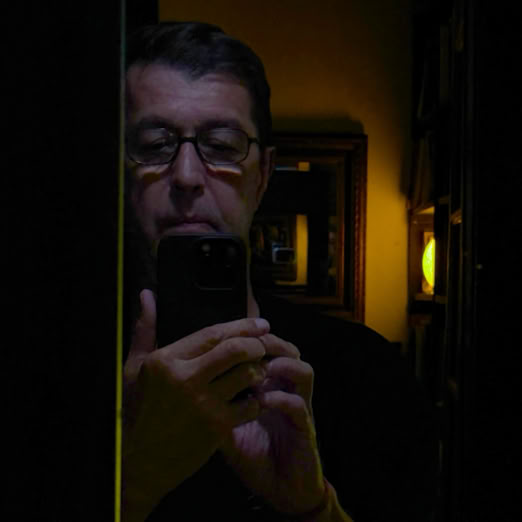
The exact recording of perceptual traps, which function as traps just as we automatically correct, actually seen in the convention of reality we should see, also follows a peculiar attitude in self-portraits.
Well, as a photographer becomes an equivalent element of what surrounds him or what he looks like, it's a mirror, often damaged, in glass doors and windows, and very often if he looks more closely - in the vases. And in general, as if nothing is in their place or everything is in their place, but secret. No interior is separated from the exterior. Out-of-the-box exists as a realistic picture in the private space, the private space exits and becomes a part of the exterior. So one of the photographs, apparently atypical and conventionally realistic, the wind-curtain curtain actually only exalts the exterior of the invisible momentum of the wind from the conjunction or nothing of the whites of the world beyond privacy, which is so important in this work.
Of course, the theoretical challenge is to interpret this work as a postmodernist version of Calderon's life as a dream or to open the subject of Platonism with category analyzes and shading - the truthfulness of ideas and suspicions in their truthfulness. Of course, it is challenging in the work with so many interpretations to mirror all the paintings and photographic mirrors of Velasquez's grand jumper in Las Meninas, through Parmigian's self-portraits to the stains of Egon Schiele - beyond the examples that the author is well-known. But as if it was unnecessary.
More interesting is the encounter with a photo that does not seek an alibi out of itself and thus returns to the very beginnings - the astonishment seen and capturing that vision just as it is. If there is anything in this work that would somehow open outline issues, it is a question of reality as a convention, but it is also an eternal question based on all visual professions.
Triptych as the name of the exhibition and the design idea is not random. As I come up with a classical image that is structured in a clear hierarchy of motifs, tryptic is the most long-lived narrative form in which the central theme is in some or more expected contexts, which requires longer viewing. Most of the exhibited photographs only reveal what we actually see.
Or does not reveal it.
Waiting for a look in which to be seen hidden.